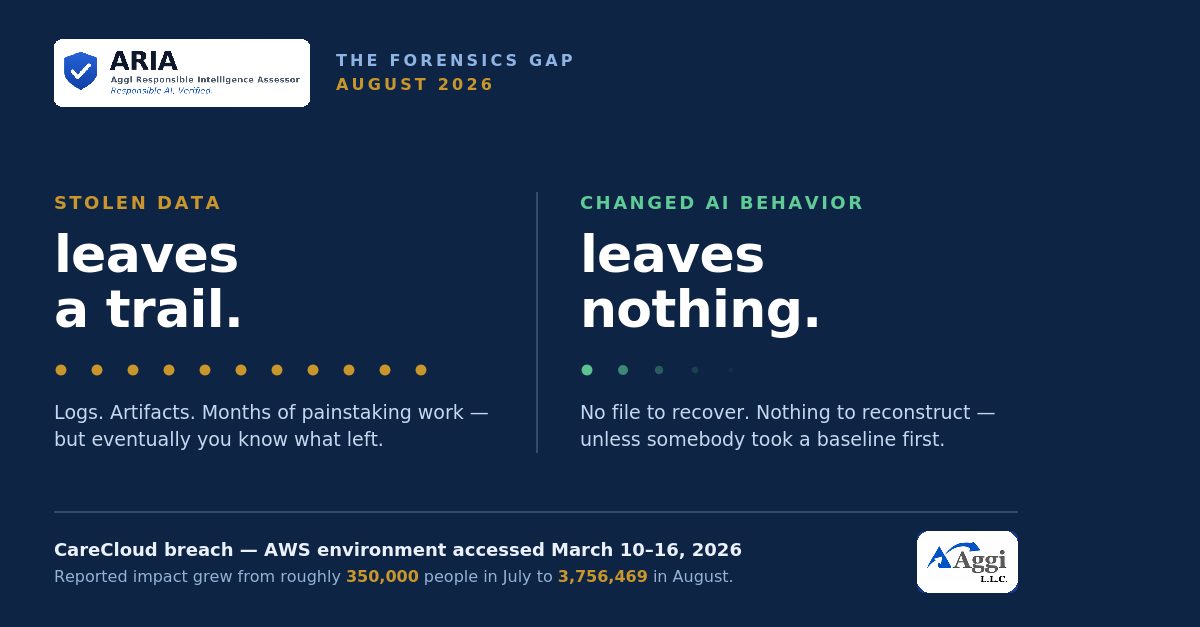
Between March 10 and March 16 this year, attackers were inside one of CareCloud's Amazon Web Services environments for six days.
CareCloud sells cloud software for the EHR (the electronic health record, the digital chart your doctor's office keeps on you), along with billing and practice management. More than 45,000 healthcare providers run on it.
In early July, state filings put the number of affected people at roughly 350,000. In August the federal breach tracker at Health and Human Services listed 3,371,508. The next day it read 3,756,469.
The exposed data included names, addresses, dates of birth, Social Security numbers, driver's license numbers, bank account and card numbers, and medical and health insurance information.
Almost none of those 3.7 million people have heard of CareCloud. They were patients of practices that chose a vendor.
First, four months passed between "we contained it" and "we know what left," and the count grew roughly tenfold along the way. I do not read that as negligence. Reconstructing an exfiltration, which means working out exactly which records left the building, is genuinely hard work. It does tell you how long the honest answer takes.
Second, there is a question I cannot put down. Data forensics is a mature discipline. It is slow and painful, but it works, because there are logs and artifacts, and eventually you can say what happened.
Now ask the same question one layer over.
If an attacker spent six days near your AI systems (the models, the prompt templates, the retrieval corpus they draw on), could anyone reconstruct whether the behavior changed? There is no exfiltrated file to recover. A model that starts answering differently leaves no artifact at all, unless somebody was measuring it beforehand.
That is not carelessness; nobody told them they needed one.
So the honest question for anyone running vendor AI, meaning AI inside software you bought rather than built, is whether you have any way to tell whether its behavior changed last month, or whether that visibility stops at the vendor's front door.
We work in AI compliance, so we have a horse in this race. We raise it anyway, because we do not think the answer is comfortable for anyone right now, vendors included.
Aggi ARIA (Aggi Responsible Intelligence Assessor) tests whether an AI system actually follows the policy it is supposed to follow, continuously, with each finding mapped to the framework clause it touches. Start a conversation →
Written for people who have to make decisions about AI. What happened, why it matters, and what to do about it, with every source linked so you can check the work yourself.
The newsletter is published on LinkedIn. Subscribe there and LinkedIn will let you know when each new issue is out.
Subscribe on LinkedInLinkedIn handles your subscription; we never see or store your email address.